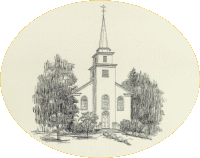
"This is a living Church of Jesus Christ. This is a
building and a congregation in which are enshrined the vital traditions of
America -- preserving and projecting the living fact of Christ and the living
fact of America."
The Rev. Charles Kellogg, shortly after the
building was moved and restored in 1960.
The History of the Old South Haven Church
While it is not definitely known when the Old South Haven Church
began to worship, most probably the organizer was The Rev. George Phillips about
the year 1717. At that time the "Town" church was situated in Setauket, NY
on the north shore of Long Island. The growing settlement on the south
shore of the Town of Brookhaven found traveling to worship in Setauket very
difficult.
 |
The 1828 building as it appeared on South Country Rd. about 1900.
This is the oldest picture found so far of the church.
|
The first building was erected in 1740, later burned to the
ground, and the present "meeting house" was constructed in 1828.
The first resident minister seems to have been Nehemiah Greenman
in 1748, then followed by Abner Reeve, but
it was the third resident, David "Priest" Rose, who is most fondly remembered.
David Rose was born in Connecticut and educated at Yale to be a doctor. It
is not known why he later turned to the ministry, although his medical knowledge
enabled him to minister to bodies as well as souls. He provided great
leadership to the church during the trying years of the Revolutionary War.
His sermons and influence did much to arouse a sacrificing patriotism among
members, and it is recorded that at a congregational meeting on June 13,
1774, with Wm. Smith as Moderator, it was voted that: the Act of
Parliament for blocking up the port of Boston is unconstitutional and has a
direct tendency to enslave the inhabitants of America; that the Colonies should
unite and adhere to a non-importation policy from Great Britain and the West
Indies, and have no trade with them; that certain persons be a standing
committee to correspond with the Committee of Correspondence in the city of New
York, and that these sentiments be communicated to them.
Many members of the Old South Haven Church subsequently played
dramatic parts in the Revolutionary War. Colonel William Floyd, who became
a General, sat as a representative from the Province of New York at all sessions
of the Continental Congress. He urged adoption of the Declaration of
Independence and signed it, the same bold signature which can be seen on the
first pages of the records of the church. For his loyalty to the rebel
cause, his beautiful estate in Mastic was ruined by British soldiers.
Colonel Nathaniel Woodhull, who also became a General under
George Washington, proved to be one of the first notable martyrs to the
American cause. He had been the first president of the rebel Provincial
congress of New York that had defied the English Governor Moore, and which
executed the orders of the Continental Congress. Commanding a rebel force
on Long Island, he was captured by the British. He was ordered to
humiliate himself by declaring, "God save the King!" But he replied, "God
save us all!" A soldier struck him with a sword and he died of his wound.
Judge William Smith, Lord of the Manor of St. George, was also
active with the rebels. He took the place of General Floyd in the
Provincial Congress of New York when Floyd became delegate to the Continental
Congress. He was a member of the group which in 1777 framed the state
constitution of New York. Having been forced to flee by British invasion,
the British used his estate for military purposes, making his home Fort St.
George. It was later recaptured by 80 Americans in a surprise attack
launched from Mt. Sinai on the north shore.
Colonel Josiah Smith, another member of the Old South Haven
Church, led a regiment in the Battle of Long Island. It was with this
regiment that Rev. David Rose fought.
The Old South Haven Church did not fare well during those war
years. Its pastor and most of its members were either away fighting the
British, or in exile. The meeting house was employed by British soldiers,
after they had thrown out the pews, as a stable for their horses. One
tradition states that the loft of the church was used as a barracks.
 |
The church while still in South Haven, probably about 1930.
Montauk Highway is to the left. A few of the cemetery stones can
be seen in the foreground.
|
It was not clear precisely when the first church was destroyed,
but the records do show that the present structure was built in 1828 during the
distinguished ministry of
Ezra King at a
cost of $1,959.04. This compares somewhat favorably with the 1960
restoration cost, including property, of about $50,000. The construction
in 1828 was partially financed by the sale of pews, which later proved to be an
embarrassment, for in 1899 we hear
The Rev. Frederick Frisbie pleading "that all
hereditary rights to pews be given up." There was no place to seat
visitors!
One of the more distinguished visitors at worship was the
Senator Daniel Webster. A common tradition relates that Webster had been
trying unsuccessfully for some time to hook a huge trout which he had heard was
in the river. One Sunday morning he had come to the church, and in the
middle of Ezra King's sermon, was informed in a loud whisper by one of Sam
Carman's servants who had entered, that the big fish had been sighted in the
pool below the mill. Webster tiptoed out, but was followed by a multitude,
including the minister who pronounced a hasty benediction. Daniel Webster
caught the trout, some 14½ pounds, and since there
were no cameras, the fish was held against the wall of Sam Carman's hotel and
its outline drawn there. A blacksmith, copying it, carved a weathervane
out of cherry wood, one-third larger than the fish. He gilded it, and
placed it on top of the church spire. There it remained until struck down
by lighting, and the
original carving is now exhibited at the Bellport-Brookhaven Historical
Society; and a replica
can now be found on the church spire. As for the fish, tradition states
that it was taken to Delmonico's where it was devoured by the Senator and his
friends.
The Rev. King's interest in education
caused him to establish an academy in neighboring Bellport, the "Bellport
Classical Institute." The building is now used as a private residence,
although the street retains the name of Academy Lane.
While the design of the 1828 church building was similar to the
present structure, there were several notable differences. The entrance to
the meeting house was through two doors on either side of the steeple (there
placement is still visible on the inside walls), and there was a "high" pulpit
between them beneath the steeple, with the pews facing the entrances (there was
no balcony). Late arrivals and early departures would have been in full
view of both minister and congregants.
During the 19th century, the interior of the church building was
twice remodeled. In 1861, the two door entrances were replaced by a single
entrance through the steeple, a balcony and narthex erected, the direction
of the pews reversed, and a lower pulpit platform placed at the opposite end.
It was at that time that the clock, which still is placed on the balcony rail,
was given by Samuel Carman, Jr., and two Hepplewhite chairs were donated by Mrs.
Mary Floyd Ireland for use in the pulpit (these chairs eventually became too
fragile for regular use, and are now on loan to the Bellport-Brookhaven
Historical Society). In 1873 or 1874, lightning struck the steeple and
severely damaged it. This event initiated a second remodeling. The
steeple was repaired to its present appearance, the "Amen benches" to the right
of the pulpit were replaced by a choir box, and the interior painted a drab
brown with a border, popular with the Victorians.
In 1939, during the pastorate of the Rev. George Borthwick, the
interior received its third remodeling. The "Amen pews" were restored to
the right of the pulpit, the interior walls and pews were repainted to the
original off-white, and a new pulpit reading desk installed. The general
appearance of the church was again similar to its early 19th century style --
the principal differences being the orientation of the pews and pulpit, and the
presence of a balcony.
On October 18, 1945, the parish accepted the Brookhaven Methodist Church
property on Beaverdam Road (and in a separate coordinated transaction, the
Methodists accepted the independent Bellport Presbyterian Church property.)
The old Methodist Church building had better facilities for worship and
meetings, and by 1960, the old South Haven Church building was unused and in
need of repairs.
 |
The church as presently situated in Brookhaven Hamlet
|
On December 29, 1960, under the leadership of the
Rev. Charles Kellogg, the
historic South Haven Church building was moved from
its original location at the "goin' over" of the Carman's River,
to its present location in Brookhaven. As part of this transaction, the
church acquired and renovated the Post Carriage House (built about 1900) which
became the congregation's Parish Hall. An addition was added to the rear
of the main church building, and two entrance doors were added from this room to
the main church. On completion of renovations, the Brookhaven Church
building was sold and is now a private residence.
These were some of the great names
associated with Old South Haven Church, and some of the more dramatic events in
the live of the parish.
More important by far is the long list of members and friends through the
centuries who have worshiped in this congregation and who have made sacrifices
that it might live and continue Christ's work. These are our spiritual
ancestors, the communion of saints, and what they began we shall dedicate
ourselves to carry on.
First to Almighty God, and then to one another,
let us express our gratitude for the hundreds of persons who have
contributed so that the past might continue to live and inspire the
future.
|